Tutorial 3: GAT implementation
Outline
Implementation of GAT
Official resources: * Code
[ ]:
import os
import torch
os.environ['TORCH'] = torch.__version__
print(torch.__version__)

!pip install -q torch-scatter -f https://data.pyg.org/whl/torch-${TORCH}.html
!pip install -q torch-sparse -f https://data.pyg.org/whl/torch-${TORCH}.html
!pip install -q git+https://github.com/pyg-team/pytorch_geometric.git
1.12.1+cu113
     |████████████████████████████████| 7.9 MB 5.8 MB/s
     |████████████████████████████████| 3.5 MB 5.2 MB/s
  Building wheel for torch-geometric (setup.py) ... done
[ ]:
import numpy as np
import torch
import torch.nn as nn
import torch.nn.functional as F
Structure
[ ]:
class GATLayer(nn.Module):
    """
    Simple PyTorch Implementation of the Graph Attention layer.
    """
    def __init__(self):
        super(GATLayer, self).__init__()

    def forward(self, input, adj):
        print("")
Let’s start from the forward method
Linear Transformation
\[\bar{h'}_i = \textbf{W}\cdot \bar{h}_i\]
with \(\textbf{W}\in\mathbb R^{F'\times F}\) and \(\bar{h}_i\in\mathbb R^{F}\).
\[\bar{h'}_i \in \mathbb{R}^{F'}\]
[ ]:
in_features = 5
out_features = 2
nb_nodes = 3

W = nn.Parameter(torch.zeros(size=(in_features, out_features))) #xavier paramiter inizializator
nn.init.xavier_uniform_(W.data, gain=1.414)

input = torch.rand(nb_nodes,in_features)


# linear transformation
h = torch.mm(input, W)
N = h.size()[0]

print(h.shape)
torch.Size([3, 2])
Attention Mechanism
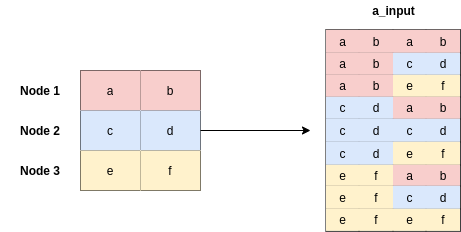
[ ]:
a = nn.Parameter(torch.zeros(size=(2*out_features, 1))) #xavier paramiter inizializator
nn.init.xavier_uniform_(a.data, gain=1.414)
print(a.shape)

leakyrelu = nn.LeakyReLU(0.2)  # LeakyReLU
torch.Size([4, 1])
[ ]:
a_input = torch.cat([h.repeat(1, N).view(N * N, -1), h.repeat(N, 1)], dim=1).view(N, -1, 2 * out_features)
[ ]:
e = leakyrelu(torch.matmul(a_input, a).squeeze(2))
[ ]:
print(a_input.shape,a.shape)
print("")
print(torch.matmul(a_input,a).shape)
print("")
print(torch.matmul(a_input,a).squeeze(2).shape)
torch.Size([3, 3, 4]) torch.Size([4, 1])

torch.Size([3, 3, 1])

torch.Size([3, 3])
Masked Attention
[ ]:
# Masked Attention
adj = torch.randint(2, (3, 3))

zero_vec  = -9e15*torch.ones_like(e)
print(zero_vec.shape)
torch.Size([3, 3])
[ ]:
attention = torch.where(adj > 0, e, zero_vec)
print(adj,"\n",e,"\n",zero_vec)
attention
tensor([[1, 0, 0],
        [0, 0, 1],
        [0, 0, 0]])
 tensor([[-0.0579, -0.1266, -0.0399],
        [-0.0703, -0.1391, -0.0523],
        [-0.0342, -0.1030, -0.0163]], grad_fn=<LeakyReluBackward0>)
 tensor([[-9.0000e+15, -9.0000e+15, -9.0000e+15],
        [-9.0000e+15, -9.0000e+15, -9.0000e+15],
        [-9.0000e+15, -9.0000e+15, -9.0000e+15]])
tensor([[-5.7857e-02, -9.0000e+15, -9.0000e+15],
        [-9.0000e+15, -9.0000e+15, -5.2334e-02],
        [-9.0000e+15, -9.0000e+15, -9.0000e+15]], grad_fn=<WhereBackward0>)
[ ]:
attention = F.softmax(attention, dim=1)
h_prime   = torch.matmul(attention, h)
[ ]:
attention
tensor([[1.0000, 0.0000, 0.0000],
        [0.0000, 0.0000, 1.0000],
        [0.3333, 0.3333, 0.3333]], grad_fn=<SoftmaxBackward0>)
[ ]:
h_prime
tensor([[-0.5166,  0.5982],
        [-0.5531,  0.4681],
        [-0.3589,  0.5321]], grad_fn=<MmBackward0>)
h_prime vs h
[ ]:
print(h_prime,"\n",h)
tensor([[-0.5166,  0.5982],
        [-0.5531,  0.4681],
        [-0.3589,  0.5321]], grad_fn=<MmBackward0>)
 tensor([[-0.5166,  0.5982],
        [-0.0071,  0.5299],
        [-0.5531,  0.4681]], grad_fn=<MmBackward0>)
Build the layer
[ ]:
class GATLayer(nn.Module):
    def __init__(self, in_features, out_features, dropout, alpha, concat=True):
        super(GATLayer, self).__init__()

        '''
        TODO
        '''

    def forward(self, input, adj):
        # Linear Transformation
        h = torch.mm(input, self.W) # matrix multiplication
        N = h.size()[0]

        # Attention Mechanism
        a_input = torch.cat([h.repeat(1, N).view(N * N, -1), h.repeat(N, 1)], dim=1).view(N, -1, 2 * self.out_features)
        e       = self.leakyrelu(torch.matmul(a_input, self.a).squeeze(2))

        # Masked Attention
        zero_vec  = -9e15*torch.ones_like(e)
        attention = torch.where(adj > 0, e, zero_vec)

        attention = F.softmax(attention, dim=1)
        attention = F.dropout(attention, self.dropout, training=self.training)
        h_prime   = torch.matmul(attention, h)

        if self.concat:
            return F.elu(h_prime)
        else:
            return h_prime
[ ]:
class GATLayer(nn.Module):
    def __init__(self, in_features, out_features, dropout, alpha, concat=True):
        super(GATLayer, self).__init__()
        self.dropout       = dropout        # drop prob = 0.6
        self.in_features   = in_features    #
        self.out_features  = out_features   #
        self.alpha         = alpha          # LeakyReLU with negative input slope, alpha = 0.2
        self.concat        = concat         # conacat = True for all layers except the output layer.


        # Xavier Initialization of Weights
        # Alternatively use weights_init to apply weights of choice
        self.W = nn.Parameter(torch.zeros(size=(in_features, out_features)))
        nn.init.xavier_uniform_(self.W.data, gain=1.414)

        self.a = nn.Parameter(torch.zeros(size=(2*out_features, 1)))
        nn.init.xavier_uniform_(self.a.data, gain=1.414)

        # LeakyReLU
        self.leakyrelu = nn.LeakyReLU(self.alpha)

    def forward(self, input, adj):
        # Linear Transformation
        h = torch.mm(input, self.W) # matrix multiplication
        N = h.size()[0]
        print(N)

        # Attention Mechanism
        a_input = torch.cat([h.repeat(1, N).view(N * N, -1), h.repeat(N, 1)], dim=1).view(N, -1, 2 * self.out_features)
        e       = self.leakyrelu(torch.matmul(a_input, self.a).squeeze(2))

        # Masked Attention
        zero_vec  = -9e15*torch.ones_like(e)
        attention = torch.where(adj > 0, e, zero_vec)

        attention = F.softmax(attention, dim=1)
        attention = F.dropout(attention, self.dropout, training=self.training)
        h_prime   = torch.matmul(attention, h)

        if self.concat:
            return F.elu(h_prime)
        else:
            return h_prime
Use it
[ ]:
from torch_geometric.data import Data
from torch_geometric.nn import GATConv
from torch_geometric.datasets import Planetoid
import torch_geometric.transforms as T

import matplotlib.pyplot as plt

name_data = 'Cora'
dataset = Planetoid(root= '/tmp/' + name_data, name = name_data)
dataset.transform = T.NormalizeFeatures()

print(f"Number of Classes in {name_data}:", dataset.num_classes)
print(f"Number of Node Features in {name_data}:", dataset.num_node_features)
Downloading https://github.com/kimiyoung/planetoid/raw/master/data/ind.cora.x
Downloading https://github.com/kimiyoung/planetoid/raw/master/data/ind.cora.tx
Downloading https://github.com/kimiyoung/planetoid/raw/master/data/ind.cora.allx
Downloading https://github.com/kimiyoung/planetoid/raw/master/data/ind.cora.y
Downloading https://github.com/kimiyoung/planetoid/raw/master/data/ind.cora.ty
Downloading https://github.com/kimiyoung/planetoid/raw/master/data/ind.cora.ally
Downloading https://github.com/kimiyoung/planetoid/raw/master/data/ind.cora.graph
Downloading https://github.com/kimiyoung/planetoid/raw/master/data/ind.cora.test.index
Number of Classes in Cora: 7
Number of Node Features in Cora: 1433
Processing...
Done!
[ ]:
class GAT(torch.nn.Module):
    def __init__(self):
        super(GAT, self).__init__()
        self.hid = 8
        self.in_head = 8
        self.out_head = 1


        self.conv1 = GATConv(dataset.num_features, self.hid, heads=self.in_head, dropout=0.6)
        self.conv2 = GATConv(self.hid*self.in_head, dataset.num_classes, concat=False,
                             heads=self.out_head, dropout=0.6)

    def forward(self, data):
        x, edge_index = data.x, data.edge_index

        x = F.dropout(x, p=0.6, training=self.training)
        x = self.conv1(x, edge_index)
        x = F.elu(x)
        x = F.dropout(x, p=0.6, training=self.training)
        x = self.conv2(x, edge_index)

        return F.log_softmax(x, dim=1)


device = torch.device('cuda' if torch.cuda.is_available() else 'cpu')
device = "cpu"

model = GAT().to(device)
data = dataset[0].to(device)


optimizer = torch.optim.Adam(model.parameters(), lr=0.005, weight_decay=5e-4)

model.train()
for epoch in range(1000):
    model.train()
    optimizer.zero_grad()
    out = model(data)
    loss = F.nll_loss(out[data.train_mask], data.y[data.train_mask])

    if epoch%200 == 0:
        print(loss)

    loss.backward()
    optimizer.step()
tensor(1.9443, grad_fn=<NllLossBackward0>)
tensor(0.6326, grad_fn=<NllLossBackward0>)
tensor(0.6263, grad_fn=<NllLossBackward0>)
tensor(0.5154, grad_fn=<NllLossBackward0>)
tensor(0.6444, grad_fn=<NllLossBackward0>)
[ ]:
model.eval()
_, pred = model(data).max(dim=1)
correct = float(pred[data.test_mask].eq(data.y[data.test_mask]).sum().item())
acc = correct / data.test_mask.sum().item()
print('Accuracy: {:.4f}'.format(acc))
Accuracy: 0.8090