Lec_7_23 Shift operator
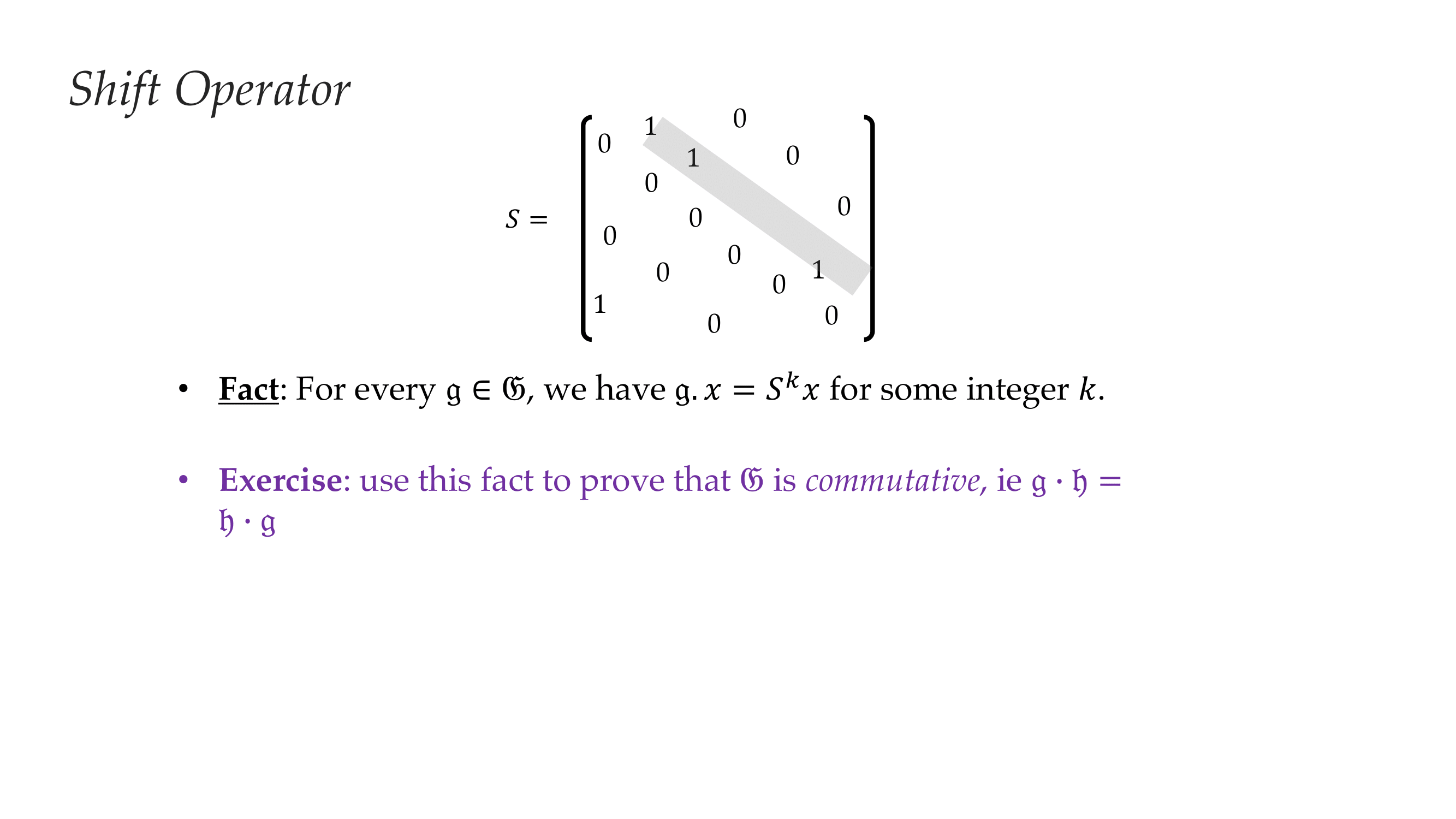
Let G be a group acting on a set X, and let g, h be elements of G and x be an element of X. We want to show that the group action is commutative, i.e., (gh)x = g(hx).
To prove this, we will use the shift operator. Let Sg denote the shift operator corresponding to the element g of G, i.e., Sg(x) = gx for any x in X. Then, we have:
(gh)x = Sgh(x) = (Sg o Sh)(x) [by definition of group action] = Sg(Sh(x)) [by associativity of group operation] = g(hx) [by definition of group action]
Therefore, we can see that (gh)x = g(hx), and the group action is commutative.
Let G be a group and let X be a set. Let g and h be elements of G and let x be an element of X. We want to show that the group action is commutative, i.e., that g(h(x)) = h(g(x)).
To prove this, we will use the shift operator. Let Sg denote the shift operator corresponding to the element g of G, i.e., Sg(x) = gx for any x in X. Similarly, let Sh denote the shift operator corresponding to the element h of G, i.e., Sh(x) = hx for any x in X. Then, we have:
g(h(x)) = Sg(Sh(x)) = (Sg o Sh)(x) [by definition of group action] = Sh(Sg(x)) = h(g(x)) [by definition of group action]
Therefore, we can see that g(h(x)) = h(g(x)), and the group action is commutative.
[1]:
import numpy as np
[3]:
shift_op = np.array(
          [[0, 1, 0, 0, 0],
           [0, 0, 1, 0, 0],
           [0, 0, 0, 1, 0],
           [0, 0, 0, 0, 1],
           [1, 0, 0, 0, 0],
           ])
[6]:
data = np.arange(25).reshape([5,5])
[7]:
data
[7]:
array([[ 0,  1,  2,  3,  4],
       [ 5,  6,  7,  8,  9],
       [10, 11, 12, 13, 14],
       [15, 16, 17, 18, 19],
       [20, 21, 22, 23, 24]])
[9]:
np.matmul(data, shift_op)
[9]:
array([[ 4,  0,  1,  2,  3],
       [ 9,  5,  6,  7,  8],
       [14, 10, 11, 12, 13],
       [19, 15, 16, 17, 18],
       [24, 20, 21, 22, 23]])
[10]:
np.matmul(shift_op, data)
[10]:
array([[ 5,  6,  7,  8,  9],
       [10, 11, 12, 13, 14],
       [15, 16, 17, 18, 19],
       [20, 21, 22, 23, 24],
       [ 0,  1,  2,  3,  4]])
[13]:
np.matmul(data, np.matmul(shift_op, shift_op))
[13]:
array([[ 3,  4,  0,  1,  2],
       [ 8,  9,  5,  6,  7],
       [13, 14, 10, 11, 12],
       [18, 19, 15, 16, 17],
       [23, 24, 20, 21, 22]])